How to Conduct a Cybersecurity Vendor Risk Assessment in UAE: Step-by-Step 2026 Guide
A practical cybersecurity vendor risk assessment UAE guide: triggers, tiering, steps, compliance, and tools for UAE audit-ready third-party security in 2026.
Imagine your company in the UAE is about to sign with a cloud provider to handle sensitive operations. Regulatory pressure around vendor risk is growing, and you know a weak process could come back to haunt you during an audit. It doesn’t help that much of the official guidance sounds vague or complex at first glance. But with a clear sense of what triggers a vendor assessment, how to group vendors, and which steps actually matter, you can build a UAE-compliant, practical routine that holds up under scrutiny—without ending up buried in paperwork or confusion.
When Vendor Risk Assessments Are Required in the UAE
You don’t need to run a full cybersecurity risk assessment for every vendor your company uses in the UAE. Take the Department of Health (DoH) in Abu Dhabi as a concrete example. Their rules say if your project falls into the Medium or High Risk category, a Vendor Risk Assessment (VRA) is mandatory before contracts get signed. If it’s labeled as No Risk, you’re officially exempt. These categories depend on what kind of data is involved, how essential the system is, and what would happen if things went wrong.
In practice, if a supplier will handle personal health data or support business-critical functions, you’re almost always dealing with at least Medium Risk. On the other hand, a service with zero data access and no real impact—like your stationary vendor—counts as No Risk and skips the assessment.
Other regulated UAE sectors, such as banking and telecom, follow similar logic. You need to map your internal vendor classifications to these regulatory risk levels, and you’ll be expected to explain your choices in any audit. If you skip assessments for critical or sensitive suppliers, you’re opening the door to trouble.
Once you’ve determined an assessment is needed, the UAE Information Assurance Regulation requires organizations to define the scope and boundaries of the risk assessment. Start by clarifying which business processes, systems, or projects the vendor will touch. Pinpoint the most critical functions that could be affected by this third-party relationship.
Next, identify and list any technical or procedural vulnerabilities connected to the information or operations at stake. This includes reviewing what security controls are already in place. For example, if a vendor will use your HR system, note which access restrictions and encryption measures you have.
The regulation also expects you to identify possible threats and their sources—these could range from malicious insiders to external attackers or even accidental data loss. Assign a risk owner for each significant risk, typically someone with direct responsibility for vendor oversight. All decisions and findings should be documented. This record serves as your evidence if regulators or auditors ever ask for details.
How UAE Organizations Tier and Categorize Vendors
Not all vendors carry the same risk, and many UAE banks use a two-factor model to streamline the process. The first factor is data sensitivity: does the vendor access personal, confidential, or regulated data, or just public information? The second is operational criticality: will a failure disrupt your core business, or is the impact minor?
Vendors that score high on both—like cloud platforms hosting financial data or operators of payment processing—are classified as critical. These require the most thorough assessments, including on-site reviews and technical deep dives. High-risk vendors (such as those running payroll or IT support) get detailed questionnaires and document checks. Vendors seen as standard risk, like providers of everyday SaaS tools, go through a lighter process. Low-risk vendors—say, catering or office furniture—are handled through contracts and periodic check-ins.
This structure helps you focus your efforts on where the risk is highest. If you’re unsure about a vendor’s tier, it’s safer to err on the side of caution and clearly record your decision.
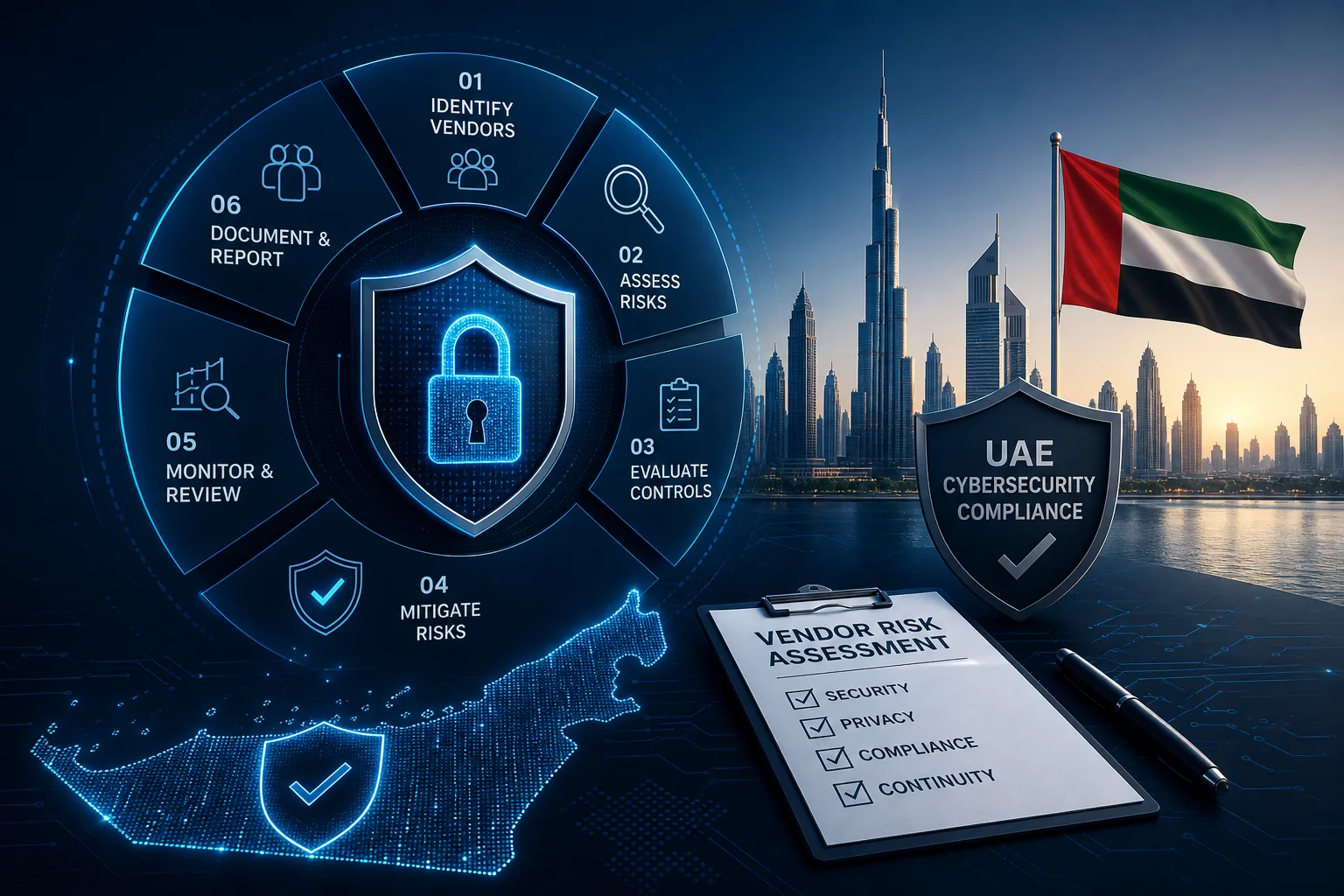
A solid cybersecurity vendor risk assessment uae guide relies on a series of practical, auditable steps. Start by making a full inventory of every vendor or third party that interacts with your data or systems. Don’t forget about those who seem minor—anyone with network access or who touches sensitive data belongs on your radar.
Next, sort each vendor by business importance, data sensitivity, and regulatory needs using your tiering approach. For every vendor, use a questionnaire tailored to their risk level: simple for low-risk suppliers, comprehensive for critical ones. Cover areas like access control, data protection, and incident response.
Request evidence to back up responses—security certifications (like SOC 2 or PCI DSS), vulnerability scan results, and penetration test reports for higher-risk vendors are standard. Review the findings, highlight the highest priority risks, and document every decision. Set a baseline risk level for each vendor and establish a routine for regular monitoring. This isn’t a one-time box to check and forget.
Tools and Evidence that Strengthen Vendor Assessments
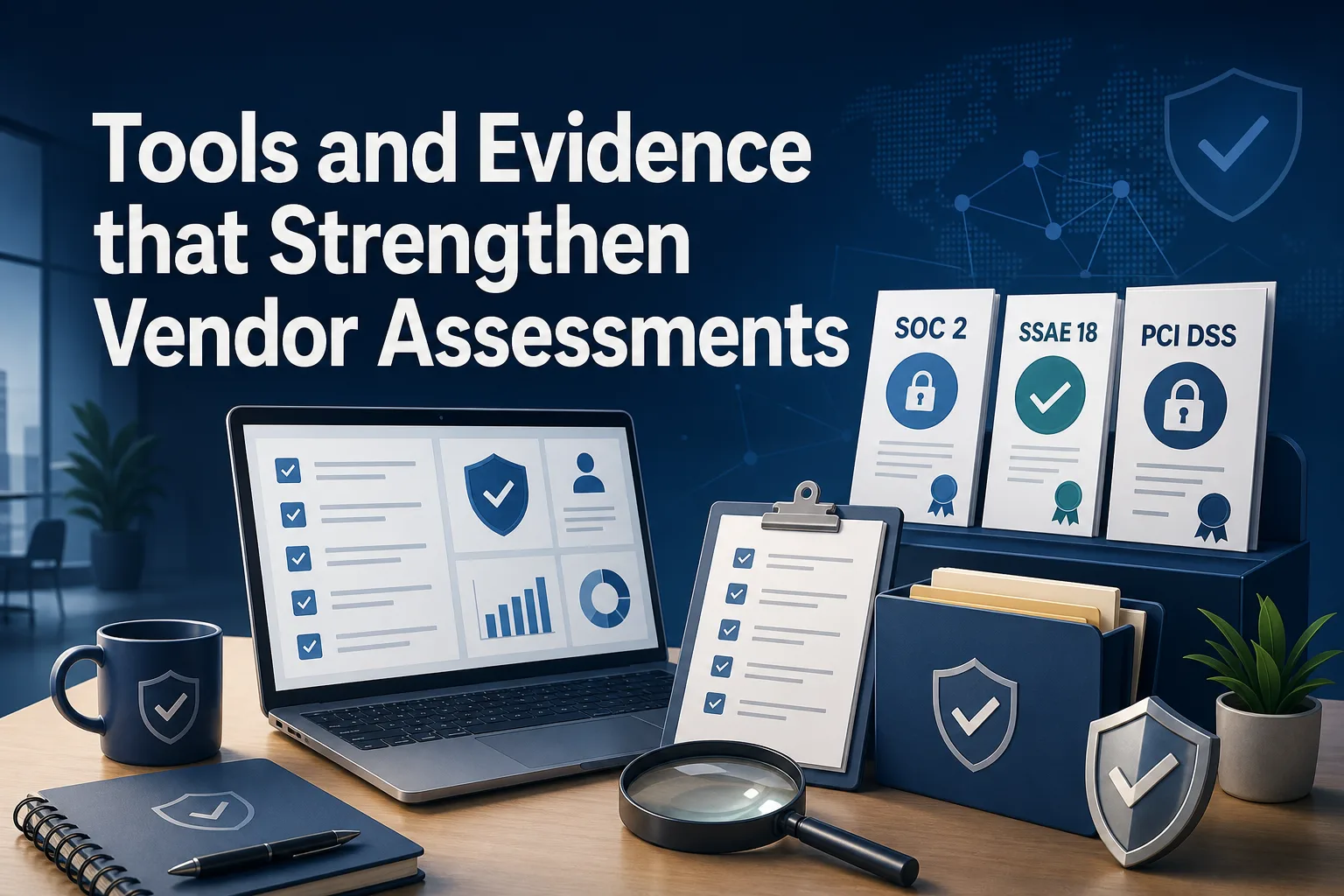
Having the right tools and documentation streamlines your assessments and makes them credible. Standard Vendor Risk Assessment Questionnaires (VRAQs) are essential—they probe everything from multi-factor authentication to incident response plans. For top-tier vendors, documents like SOC 2, SSAE 18, or PCI DSS compliance reports show that their security has been independently verified.
Automated security scanning tools can check vendors for vulnerabilities or misconfigurations, giving you more than just paperwork to rely on. For critical vendors, penetration test reports—whether provided by the vendor or done independently—validate their security controls.
For consistent risk scoring and reporting, models like FAIR let you compare vendor risks using numbers, which is especially useful for board updates or setting priorities. The right mix of tools and documents will depend on each vendor’s tier and what kind of engagement you’re planning.
How Often to Repeat Vendor Risk Assessments
A question that comes up often in UAE security circles: how frequently should these assessments happen? There isn’t a single UAE-wide rule, but industry benchmarks set clear expectations. In banking, critical and high-risk vendors are reassessed every year. For standard and low-risk vendors, every two to three years is typical—unless something major changes, like a shift in the vendor’s services, ownership, or overall risk.
If a major change occurs that could alter the risk posture of the vendor, such as changes in provided services or significant organizational shifts, it’s wise to reassess before the next scheduled cycle. Use calendars or automated reminders to keep track, and document every reassessment to show auditors you’re staying on top of things.
Linking Vendor Assessments to UAE Compliance Requirements
Evaluating a vendor’s cybersecurity isn’t only about technical controls. You also need to prove compliance with UAE legal requirements. The UAE Information Assurance Regulation requires you to define assessment scope, identify vulnerabilities, document risk identification, and assign risk owners as part of your compliance obligations.
Use your assessment process to check that vendors can meet relevant sector-specific requirements and compliance obligations. If a vendor can’t provide solid proof, consider raising their risk tier or looking for alternatives. For the most current details on sector-specific rules, refer to official regulatory portals and guidance.
Suppose an Abu Dhabi healthcare provider is considering a new cloud-based electronic medical record (EMR) vendor. According to DoH rules, a Vendor Risk Assessment is required before onboarding if the project is classified as Medium or High Risk.
Before any contract is signed, the provider must run a complete Vendor Risk Assessment. The team should specify exactly what data the EMR vendor will access, review their tech controls for confidentiality and uptime, and make sure they meet Information Assurance standards. The assessment can include verifying key controls aligned with UAE cybersecurity best practices.
If any area falls short—say, weak backup practices or poor access controls—the provider should require fixes before going live. Following this process not only satisfies DoH rules but also raises the standard for future vendor partnerships in sensitive environments.
Treating vendor risk assessment as a one-off checklist leaves you open to blind spots and unexpected issues. It’s more effective to build it into your routine security and governance practices. Set up automated monitoring for your most critical vendors—many tools can alert you to new vulnerabilities or compliance gaps as they happen.
Regularly update your vendor inventory, especially when new projects or suppliers come on board. Make reassessments a scheduled part of your year, not just a last-minute scramble before an audit. Train procurement and business teams to flag risks as contracts or data flows change, so nothing slips through unnoticed.
Above all, keep detailed records of every assessment, decision, and follow-up. This audit trail protects your company and shows regulators you take third-party risk seriously. With a steady, organized approach, UAE organizations can meet regulatory expectations and reduce vendor-related surprises—without turning vendor risk management into a bureaucratic maze.