How to Design a Tiered SaaS Pricing Model for Emerging Markets: Benchmarks and Step-by-Step Guide
Discover how to design tiered SaaS pricing for emerging markets with real benchmarks, PPP methods, and a proven iterative framework. Practical guide for SaaS founders.
Picture a founder in Lagos or Nairobi, finally launching a SaaS product after months of late nights and tough calls. The demos go well, but when potential customers reach the pricing page, the excitement fades. People hesitate: “That’s out of our range.” “Do you accept our currency?” “We only need a piece of this, not the whole thing.” These aren’t rare objections—anyone building SaaS for emerging markets hears them again and again. The real challenge isn’t just lowering the price. It’s about building a tiered SaaS pricing structure that fits how these markets actually work, keeps your business afloat, and helps you grow. That takes more than guesswork: you need real-world benchmarks, smart localization, and a willingness to test until you get it right.
Why Three Tiers Still Work in Emerging Markets
Three-tier pricing didn’t start in Silicon Valley by accident, and it hasn’t stuck around just for tradition’s sake. For SaaS teams everywhere, it’s the most practical way to match what different customers need and can afford. The standard breakdown—Starter, Professional, Enterprise—lines up with the typical spread you’ll find in emerging economies. Starter is for solo founders and tiny teams trying something new. Professional is for small but growing businesses. Enterprise is for larger companies that want custom features or more support.
You can see this play out in LaunchPad Africa’s real pricing models for B2B SaaS: ₦8,000, $20, or GHS 120 per month for Starter; ₦25,000, $62, or GHS 375 for Professional. Enterprise plans are custom, usually for teams bigger than 15 or with special needs. These numbers aren’t random—they match what local companies actually pay.
Most revenue in these regions nearly always comes from the Professional, or middle, tier. That’s the plan with enough horsepower for teams that have outgrown free tools, but it doesn’t scare off ambitious startups. By keeping Starter risk-free and making Professional the clear “main” choice, you encourage upgrades without locking people into plans they’ll never use. These patterns show up again and again in African SaaS data and in stories from founders across the Global South.
Regional Tier Names and How to Cluster Countries
The way you name your tiers and group countries isn’t just cosmetic—it’s essential for making pricing work without creating a mess. Instead of managing dozens of individual country plans, experienced SaaS teams cluster countries into a handful of regional groups. Leading SaaS pricing sources recommend clustering countries into three main groups. Premium covers high-income markets, Core is for countries with moderate purchasing power, and Value is for the most price-sensitive or fast-growing markets.[S1][S4][S5]
Think of Nigeria, Ghana, and Kenya together in a Value group focused on easy adoption, while South Africa and Egypt might go into Core with mid-range pricing. Premium can be saved for places like the UAE or developed Asian markets, where expectations and willingness to pay are higher. This avoids endless tweaking and keeps your pricing model clean.
Naming your plans matters, too. “Starter” sounds right in one place, but “Lite” or “Basic” might feel better elsewhere. In the Value cluster, highlight affordability and core features instead of making it seem stripped down. “Professional” should point to what most businesses truly need, and “Enterprise” or “Premium” should flag special support or integrations for those who demand it.
Clustering makes your pricing page easier for customers and helps you handle things like tax, payment, and support as you grow into more countries.
Using PPP to Set Fair Local Prices
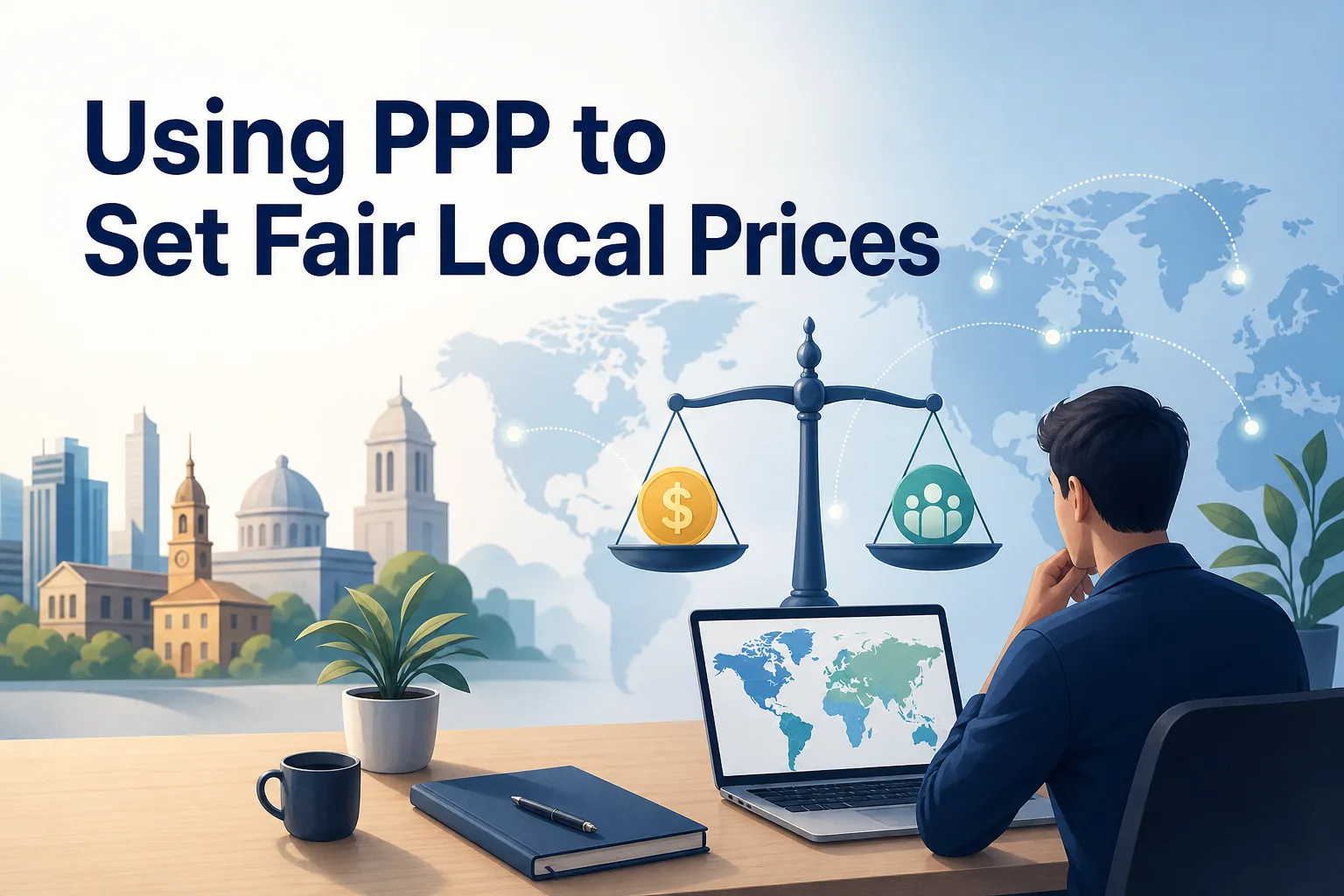
One of the hardest decisions is how to set prices that are fair in local terms but still let your SaaS survive. The approach I’ve seen work best is to start with your USD price, then adjust using purchasing power parity (PPP) numbers from trusted sources like the World Bank or OECD. This avoids the trap of just converting at the day’s exchange rate, which rarely matches what people can actually afford.
The process is practical: decide your base USD price for each tier—$20 for Starter, $62 for Professional, for example. Find the PPP factor for your target country. Multiply: Base Price × PPP Factor = Local Price. If the PPP for Ghana points to 40% lower purchasing power than the US, your Ghana price should be 40% less than the US price, not just whatever the currency market says that day.
Always show prices in both the local currency and USD, especially where some customers pay with international cards or compare you to global competitors. LaunchPad Africa advises Nigerian SaaS products to show both Naira and USD. That transparency builds trust and helps buyers know where they stand.
Don’t skip tax and compliance. Microsoft’s SaaS guidance is clear: you must include local VAT, GST, or currency rules in your pricing. If you don’t, you risk unexpected costs or compliance messes later. Build tax logic and multi-currency options into your pricing system from the beginning.
How to Set Gaps and Entry Points Between Plans
The difference between your plans matters as much as the headline price. If there’s barely any gap between Starter and Professional, people get confused. If the jump is huge, upgrades stall out. The best results, according to M Accelerator and several SaaS pricing guides, come from setting a gap of 50–100% between each tier.
So, if Starter is $20/month, Professional should land between $30–40 at minimum, and not more than $60–80 unless you’re adding a ton of new features. This keeps each tier clear and prevents customers from freezing up over small differences.
Entry-level pricing should tie back to results. M Accelerator suggests Starter should cost 5–20% of the monthly ROI your product delivers. If your SaaS saves a business $1,000 a month, a $20–$50 starting tier is a reasonable ask. This keeps the barrier low for new users but shows there’s real value.
Divide features with intent. Basic integrations, analytics, or a limited number of users belong in the first plan. Professional should open up more automation, richer reporting, or higher usage. Save things like SSO, dedicated support, or custom SLAs for Enterprise. Link each plan to clear value measures—like user count, API calls, or projects—so users can see exactly what they’ll get as they expand.
Iteration and Testing: The Only Way to Get Pricing Right
No pricing model gets everything right the first time, and you can’t afford to treat it as a one-off decision. LaunchPad Africa’s five-step loop is a solid approach: launch with three tiers, gather feedback (especially from people who don’t buy), tweak one thing at a time—maybe the price, maybe which features are included—track what happens to conversion, ARPU, and churn, then stick with the change or roll it back. Each test should run for at least a month or 100 trial signups to get real data.
This process turns pricing into something you actually learn from. Say you notice Ghanaian users drop off at the Professional tier. Before you cut prices, try moving a popular feature to Starter or test a regional discount for a month. Watch the numbers: does churn go down? Do more people upgrade?
Monetizely recommends a similar playbook: dig deep into market and cost data, map out customer value by segment, and run controlled experiments in a few regions before rolling out bigger changes. Stripo Research also stresses that you should always communicate pricing changes clearly to customers—no surprise rate hikes or hidden charges. That honesty builds trust and keeps churn from spiking when you adjust your model.
Payments, Costs, and Compliance—Don’t Skip the Details

Rolling out a tiered SaaS model for emerging markets isn’t just about what’s on your pricing page. Local payment habits, your true costs per customer, and regulatory red tape can all make or break your strategy.
Start by adding the payment methods your target customers actually use. In Africa and Southeast Asia, many customers rely on mobile money, bank transfers, or cash vouchers as important payment options alongside credit cards. If your SaaS only handles international cards, conversions will lag behind, no matter how attractive your pricing looks.
Then, calculate what it really costs you to serve each customer in every region. Monetizely urges founders to factor in local support, hosting, and distribution. Sometimes, a plan that looks affordable up front ends up losing money if you don’t count these costs.
Tax compliance is mandatory. VAT or GST can change not just by country but even within certain regions. Microsoft’s guidance for SaaS pricing calls out the need to automate tax calculations and show tax-inclusive prices whenever the law says so. Miss this, and you risk fines or payment processor headaches.
Keep checking what users in each region value most. What’s a must-have in Kenya could be barely used in South Africa. Regular reviews help you match your tiers to real needs and willingness to pay in every cluster.
From Rollout to Real Growth
Launching your tiered pricing is just the starting line. The real work is in how you roll out and keep improving as you grow.
Begin with one or two regional clusters, set up your three tiers, and adjust prices using PPP as your anchor. Track signups, feedback, and conversions closely. As you learn what works, bring in more regions and tweak where needed—what succeeds in Nigeria may need a different approach in Ghana or Kenya.
Growth doesn’t have to mean chaos. By clustering countries and sticking to a clear pricing system, you can expand to 10 or 20 markets without turning your back office into a maze. Use tools that let you display multiple currencies, support local payments, and handle tax rules automatically, so your team isn’t buried in manual work.
Keep your pricing loop alive by making pricing review part of your regular operations. As your SaaS grows, you might spot a chance for a new premium plan, or see demand for a “Lite” version among microbusinesses. How often you review depends on your growth and changes in local markets—check your data and customer feedback for the right timing.
Most of all, respect the way each market works, all the way from plan names to the final payment step. The founders who do this well treat pricing as an ongoing project—one they’re always adjusting based on real data and feedback. That’s what keeps SaaS businesses thriving in emerging markets.